5 takeaways as US enters war with Iran, strikes nuclear sites
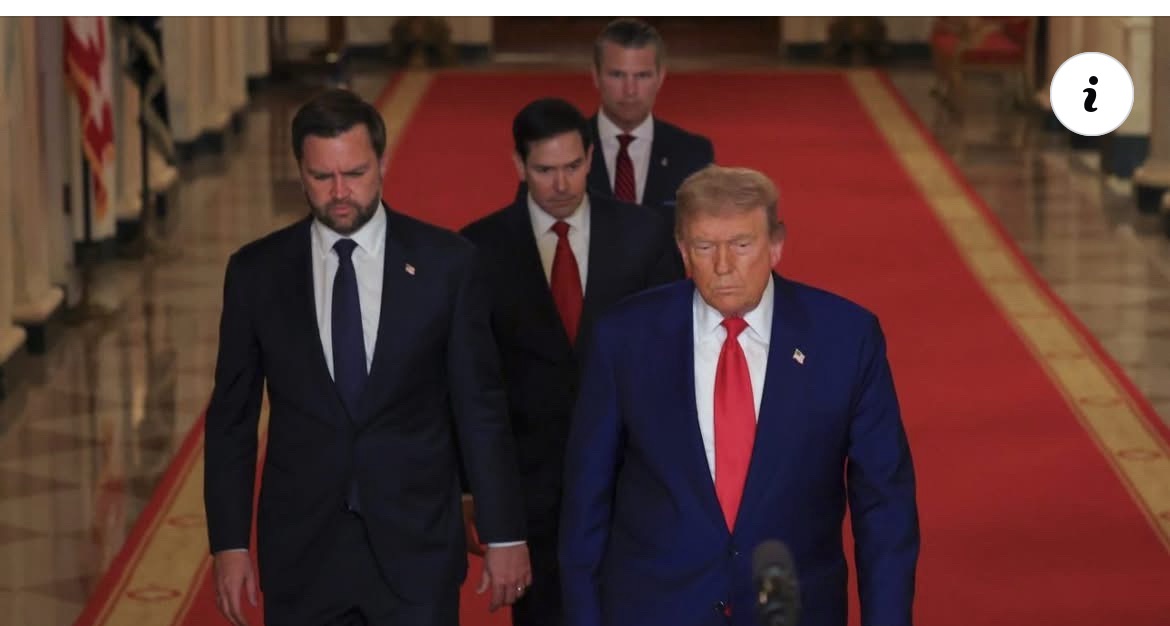
President Trump announced Saturday night that the United States has bombed three nuclear sites in Iran, engaging U.S. forces in a war that Israel launched two weeks ago.
In a brief address on Saturday night, Trump warned of continued U.S. attacks on Iran if “peace does not come quickly.”
“This cannot continue,” he said, flanked by Vice President Vance, Defense Secretary Pete Hegseth and Secretary of State Marco Rubio.
“There will be either peace or there will be tragedy for Iran, far greater than we have witnessed over the last eight days,” Trump said.
The White House had said on Thursday that Trump would make a decision on bombing Iran within two weeks, but B‑2 bombers started crossing the Pacific on Saturday afternoon.
Trump announced the “very successful” strikes in a Truth Social post around 8 p.m. EDT Saturday. In his remarks on Saturday night, the president said those facilities “have been completely and totally obliterated.”Live updates: Trump calls for peace after bombing 3 Iran nuclear sites
Here are the key takeaways on the bombings:
U.S. bombs, missiles strikes three nuclear sites
In his Truth Social post, Trump said “a full payload of BOMBS” was dropped on Iran’s primary nuclear enrichment plant, Fordow — a deep underground facility viewed as key to Tehran’s nuclear program — as well as on Natanz and Isfahan.
Multiple outlets reported that six “bunker buster” bombs were dropped on the Fordow facility, and that 30 tomahawk missiles were fired at Natanz and Isfahan.
Trump, in his address, said Defense Secretary Pete Hegseth and Joint Chiefs Chairman Gen. Dan Caine would give a press conference on the strikes at 8 a.m. EDT Sunday.
Experts say the 30,000-pound bunker busters, officially known as the GBU-57 Massive Ordnance Penetrators, could penetrate the mountain where Fordow is located, had reportedly been requested by Israel.
In the hours before the U.S. unleashed airstrikes, the Defense Department reportedly moved B‑2 bombers, the only aircraft capable of dropping the GBU-57, from their holding base in Missouri to across the Pacific to Guam.
Iranian officials and state media have confirmed the bombings, but said the three nuclear facilities had previously been evacuated.
Lawmakers divided, some raise constitutionality concerns
The immediate response from lawmakers on both sides of the aisle pointed to the deep divisions over whether the U.S. should enter a new war in the Middle East.
“This is not Constitutional,” Rep. Thomas Massie (R‑Ky.) posted on X.
Rep. Jim Himes (D‑Conn.) struck a similar note, referencing Trump’s post announcing the attacks, which said, “Thank you for your attention to this matter.”
“According to the Constitution we are both sworn to defend, my attention to this matter comes BEFORE bombs fall. Full stop,” Himes wrote.
Massie had sponsored legislation that would have required congressional approval for any strikes on Iran.
Sen. Bernie Sanders (I‑Vt.) reacted to the news during a rally in Tulsa, Okla., calling it “grossly unconstitutional” after the crowd chanted “no more war.”
Leading Republicans and at least one Democrat were supportive of the attacks.
“The President’s decisive action prevents the world’s largest state sponsor of terrorism, which chants ‘Death to America,’ from obtaining the most lethal weapon on the planet. This is America First policy in action,” Speaker Mike Johnson (R‑La.) wrote on X.
“Good. This was the right call. The regime deserves it,” Sen. Lindsey Graham (R‑S.C.) wrote on X.
Senate Armed Services Committee Chair Roger Wicker (R‑Miss.), meanwhile, said Trump had made “a deliberate —and correct— decision to eliminate the existential threat posed by the Iranian regime.”
Sen. John Fetterman (D‑Penn.) also backed the strikes.
“As I’ve long maintained, this was the correct move by @POTUS . Iran is the world’s leading sponsor of terrorism and cannot have nuclear capabilities,” he wrote on X.
Where U.S. troops are most vulnerable
Some 40,000 U.S. service members are spread out across the Middle East at bases in Syria, Iraq, Jordan, Kuwait, Bahrain, Qatar and the United Arab Emirates, offering Iran a broad opportunity to hit back at American citizens, equipment and interests.
In the days before the U.S. strike on Iran, Tehran’s Supreme Leader Ayatollah Ali Khamenei warned that any American military intervention in its conflict with Israel “will undoubtedly be accompanied by irreparable damage.”
And on Saturday, a news anchor on Iranian state television declared that Trump, “started it, and we will end it,” seeming to refer to a larger conflict between Washington and Tehran. The broadcast also showed a graphic of American bases in the Middle East with the headline, “Within the fire range of Iran,” as reported by The New York Times.
Experts say Iran within hours could decide to launch a retaliatory strike on the nearby Al-Asad Air Base in Iraq or other locations closest to its borders, and within minutes of such a decision could have its missiles delivered.
“If [Iran] had the ballistic missiles ready to go, those strikes could happen in under 15 minutes. Launched to target,” retired Col. Seth Krummrich, vice president at security consultancy firm Global Guardian, told The Hill on Friday.
A former Special Forces officer in Iraq and Afghanistan, Krummrich also predicted that if the U.S. were to use the GBU-57, “you would see an Iranian missile strike aimed at one or multiple U.S. bases.”
Tehran last significantly targeted U.S. troops in January 2020 after Trump, in his first term, ordered an airstrike that killed Maj. Gen. Qassem Soleimani, the head of Iran’s elite Quds Force.
Iran reacted swiftly, days later hammering Al-Asad and another U.S. base in Erbil with 13 ballistic missiles in the largest such attack ever against U.S. forces abroad. No Americans were killed in the strikes but more than 100 were later diagnosed and treated for traumatic brain injuries.
Trump jumps gun on two-week timeline
The strikes came less than 48 hours after Trump said he would make up his mind within two weeks, suggesting there was still time for a diplomatic solution.
“Based on the fact that there’s a substantial chance of negotiation that may or may not take place with Iran in the near future, I will make my decision whether or not to go in the next two weeks,” Trump said in a statement read aloud by White House press secretary Karoline Leavitt on Friday afternoon.
The U.S. has reportedly maintained dialogue with Iranian officials since Israel first struck Iran on June 13, but Trump had expressed growing skepticism about the chances of a deal.
Iran has reportedly agreed to resume direct talks with the U.S. after a meeting between European foreign ministers and Iran’s top diplomat on Friday.
This weekend saw a flurry of diplomatic activity across the Middle East.
Ambassadors from Qatar, Saudi Arabia, the United Arab Emirates and Kuwait on Saturday met with Rafael Grossi, director general of the International Atomic Energy Agency (IAEA), to express concerns about the consequences of a U.S. attack.
What happens next?
It could take days for the U.S., Israel and IAEA to assess the damage from the U.S. strikes, which were carried out in close coordination with the Israeli Defense Forces.
One of the key questions will be how much the U.S. strikes, together with over a week of Israeli attacks, have set back Tehran’s nuclear program.
Trump said in recent days he believed Iran was on the verge of being able to build a nuclear bomb, though U.S. intelligence agencies believed it would take more than a year for Tehran to turn enriched uranium into a usable nuclear weapon.
Israeli officials have also suggested that regime change in Iran is among the goals of their war, and that Khamenei could be a target for assassination.
Iran’s supreme leader, believed to be hiding out in a bunker, has named three senior clerics to replace him should he die
On Iranian state television after the attacks, an anchor said, “Mr. Trump, you started it, and we will end it,” along with a graphic of American bases in the Middle East within Iran’s reach, according to the Times.
Both Russia and China had condemned Israel’s war on Iran and are certain to criticize the U.S. strikes too. However, Russia has shown little interest in sending military support to Iran.