Trump gets major win now — but it comes with risks down the road
Donald Trump has his first major legislative victory of his second presidential term.
The “big, beautiful bill”, as he calls it, is a sprawling package that includes many key pieces of his agenda – delivering on promises he made on the campaign trail.
It also, however, contains the seeds of political peril for the president and his party.
That Trump and his team were able to shepherd the legislation through Congress despite narrow majorities in both the House of Representatives and the Senate is no small achievement.
His success required him and his allies to win over budget hawks within his Republican Party who were intent on slashing government spending, as well as centrists who were wary of cuts to social programmes.
When this congressional session started in January, there were doubts about whether House Republicans could even agree to return Congressman Mike Johnson to the speaker’s chair, let alone agree on major pieces of legislation.
Agree they did, however – as did Republicans in the Senate, a notoriously unwieldy chamber.
- Congress passes Trump’s ‘big, beautiful bill’
- A look at the key items in the legislation
- Fact-checking three claims about the bill
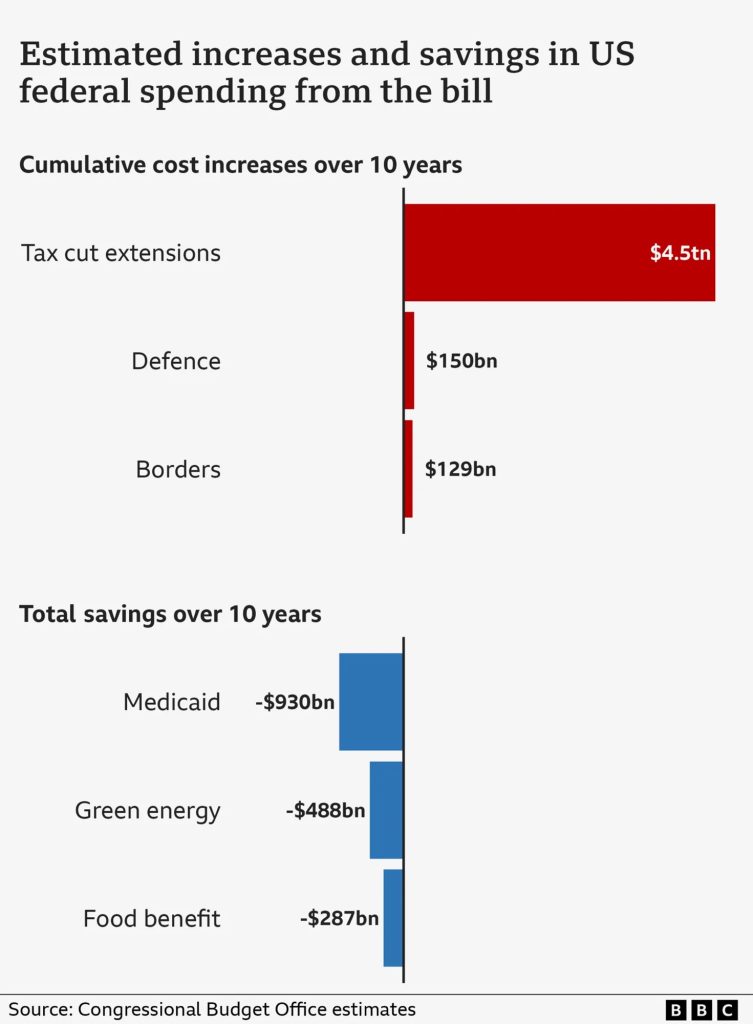
The spending package approved by lawmakers directs about $150bn (£110bn) in new spending for border security, detention centres and immigration enforcement officers. Another $150bn is allocated for military expenditures, including the president’s “gold dome” missile defence programme.
The really big numbers, however, are in the tax cuts in this legislation. They amount to more than $4.5tn over 10 years.
Some of these are cuts that were first enacted in Trump’s first term, and were set to expire before the bill makes them permanent. Others, like ending taxes on tips and overtime, where 2024 campaign promises that are implemented by will end in 2028.
All this adds up to massive new debt for the US. The White House contends that the tax cuts will spur economic growth that will generate sufficient new revenue, when taken alongside tariff collections.
But outside projections suggest that this legislation will add more than $3tn in new US debt.
As critics like Republican Senator Rand Paul of Kentucky have pointed out, the legislation raises the amount of new debt the federal government can issue by $5tn – a step that would not be necessary if the White House truly believed their budget projections.
Paul and others like tech multibillionaire Elon Musk have warned that this massive amount of debt will be growing burden on the federal government, as interest payments crowd out other spending and drive up interest rates. A fiscal reckoning is coming, they warn.
Another senator who voted against the legislation, Thom Tillis of North Carolina, had a different warning for Trump and his party. In a fiery speech on the floor of the chamber, he accused the president of breaking a promise to those who supported him — citing the bill’s cuts worth approximately $1tn to Medicaid, a government-run health insurance programme for low-income Americans.
“Republicans are about to make a mistake on healthcare and betray a promise,” he said, declaring that more than 660,000 people in North Carolina would be “pushed off” Medicaid.
A year after Trump made inroads with working-class Americans, including minority voters who traditionally have supported opposing Democrats, his legislation will cause nearly 12 million Americans to lose Medicaid coverage in the next 10 years, according to the non-partisan Congressional Budget Office.
Democrats are already preparing an onslaught of attacks against Republicans for what they say is legislation that cuts social service in order to provide tax cuts to wealthier Americans.
Although those cuts won’t come into effect until after next year’s congressional midterm elections, Democrats will try to remind American voters of the consequences the decisions Republicans made over the past few weeks.
Trump is preparing what should be a celebratory bill signing ceremony on 4 July — American Independence Day — and will tout his ability to govern not just through executive order, but also through enacting new law.
But the fight to define the benefits – and consequences – of this bill is just beginning.