How a Forgotten 1940s Chinese Typewriter Changed Modern Technology Forever!
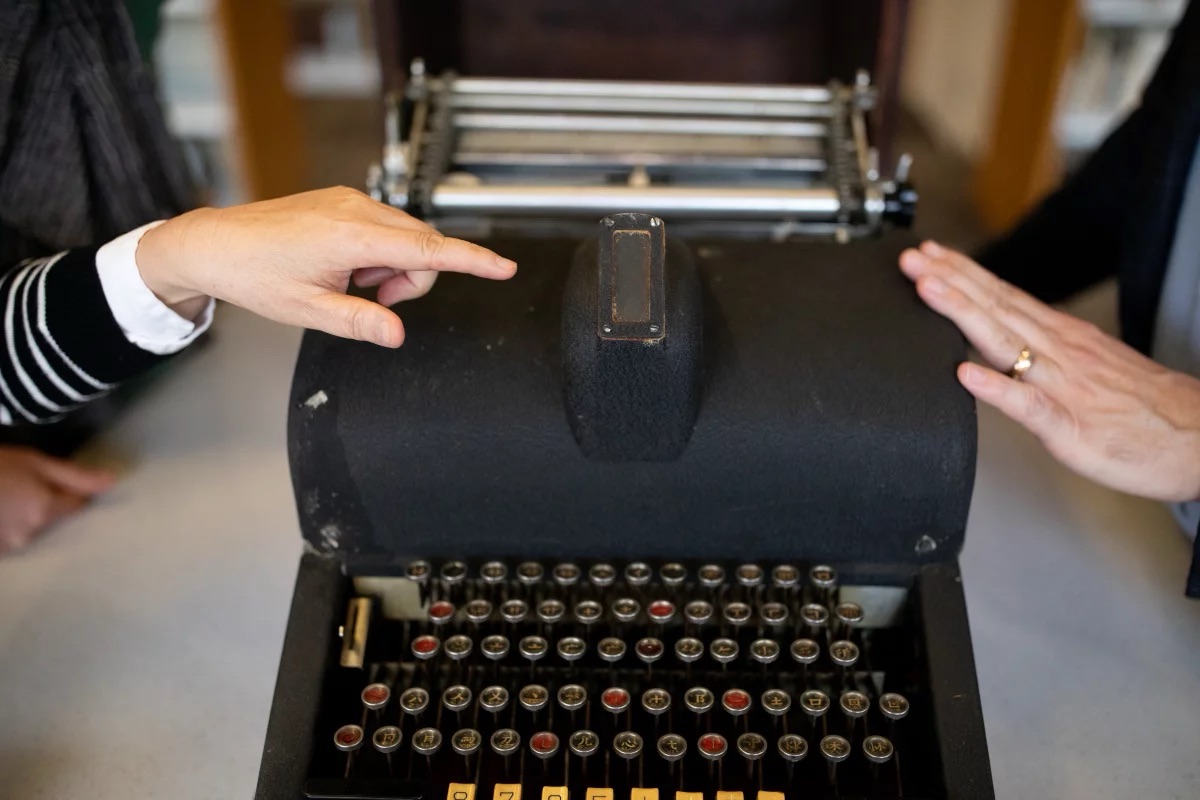

The MingKwai typewriter’s keys enable the typist to find and retrieve Chinese characters.
Elisabeth von Boch/Stanford
STANFORD, California — Scholars in the U.S., Taiwan and China are buzzing about the discovery of an old typewriter, because the long-lost machine is part of the origin story of modern Chinese computing — and central to ongoing questions about the politics of language.
China’s entry into modern computing was critical in allowing the country to become the technological powerhouse it is today. But before this, some of the brightest Chinese minds of the 20th century had to figure out a way to harness the complex pictographs that make up written Chinese into a typewriter, and later, a computer.
One man succeeded more than any other before him. His name was Lin Yutang, a noted linguist and writer from southern China. He made just one prototype of his Chinese typewriter, which he dubbed the MingKwai, “bright and clear” in Mandarin Chinese.
Detailed U.S. patent records and diagrams of the typewriter from the 1940s are public, but the physical prototype went missing. Scholars assumed it was lost to history
“I had really, truly thought it was gone,” says Thomas Mullaney, a history professor at Stanford University who has studied Chinese computing for two decades and is the author of The Chinese Typewriter.

Thomas Mullaney and Zhaohui Xue, curator for Chinese studies, examine the MingKwai prototype at Stanford University.
Mullaney was at a conference last year when he got a message that someone in upstate New York had found a strange machine in their basement and posted a picture of it on Facebook.
“It was a sleepless night. I was randomly searching who the owner might be,” Mullaney recalls, laughing.
Eventually, the owner reached out to him. They had acquired the typewriter from a relative who had worked at Mergenthaler Linotype, once of the most prominent U.S. makers of typesetting machines. The company helped craft the only known prototype of the MingKwai typewriter.
Mullaney later confirmed that the machine found in the New York basement was indeed the only prototype of Lin’s MingKwai typewriter.
“It’s like a family member showing up at your doorstep and you had just assumed you would never see them,” Mullaney says

The MingKwai’s unique design was a turning point in the history of Chinese computing.
The story of why such a typewriter even exists runs parallel to the political upheaval and conflict over Chinese identity and politics in the 20th century.
Lin, its inventor, was born in 1895 in southern China during the tail end of a failing Qing dynasty. Student activists and radical thinkers were desperate to reform and strengthen China. Some proposed dismantling traditional Chinese culture in favor of Western science and technology, even eliminating Chinese characters altogether in favor of a Roman alphabet.
“Lin Yutang charted a path right down the middle,” says Chia-Fang Tsai, the director of the Lin Yutang House, a foundation set up in Taiwan to commemorate the linguist’s work. That middle path would marry both east and west and preserve the Chinese language in the digital age.
Typing Chinese was a monumental challenge. Chinese has no alphabet. Instead, it uses tens of thousands of pictographs. When Lin started his work in the early 20th century, there was no standardized version of Mandarin Chinese. Instead, people spoke hundreds of dialects and languages, meaning there was no singular phonetic spelling of the sound of each word.
Lin had financial backing from the American writer Pearl S. Buck to create the typewriter, but he also sunk much of his own savings into the project as costs ballooned.
“He’d spent a lot of money. A lot,” says Jill Lai Miller, Lin’s granddaughter. “But he was not one to carry a grudge” against his benefactors, she says.
One last secret

The machine was acquired this year by Stanford University, which recently cleaned and restored the decades-old machine. It’s being kept in the university’s East Asia Library and will soon be on public display.
One morning in June, Mullaney carefully opened the machine’s custom wooden boxing to show how the typewriter works.
The typewriter’s ingenuity comes from the way Lin decided to break down Chinese pictographs: by their shapes, not sounds. The typist can search for certain combinations of shapes by pressing down on the ergonomic keyboard. Then, a small screen above the keyboard (Lin called it his “magic eye”) offers the typist up to eight possible characters that might match. In this way, the typewriter boasts the ability to retrieve up to 90,000 characters.
“I am not a theological, religious person. This is like Eve. This is the beginning of it all,” says Mullaney. The concepts in the MingKwai typewriter underlie how we type Chinese, Japanese and Korean today.
“What a lot of these individuals [including Lin] were trying to say is, we do not buy the notion that the only price of entry to modernity is our culture, our language, that we have to just leave that at the door,” says Mullaney.