“A Royal Throwback: Kirsten Dunst as the Young Queen in Marie Antoinette”
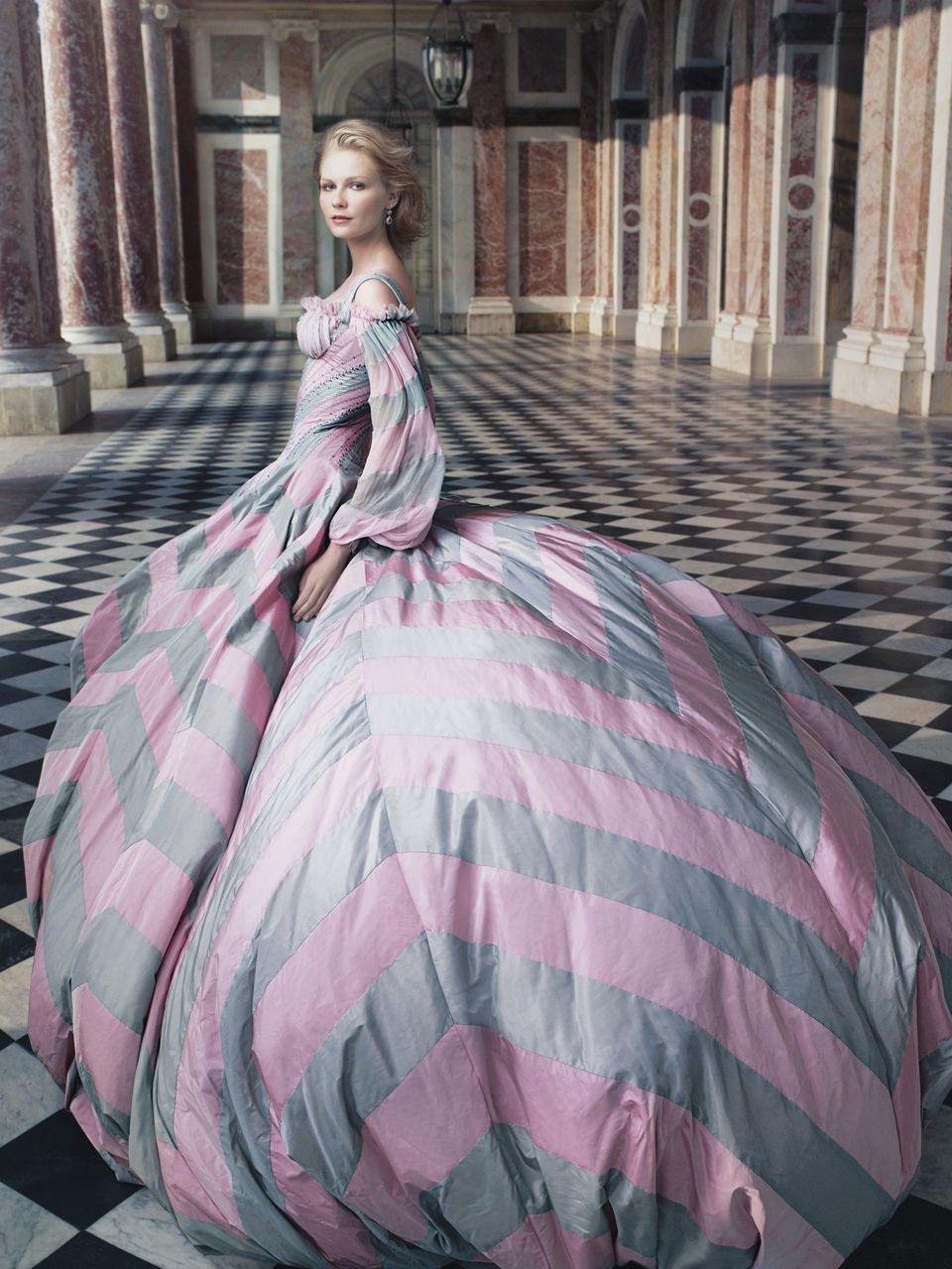
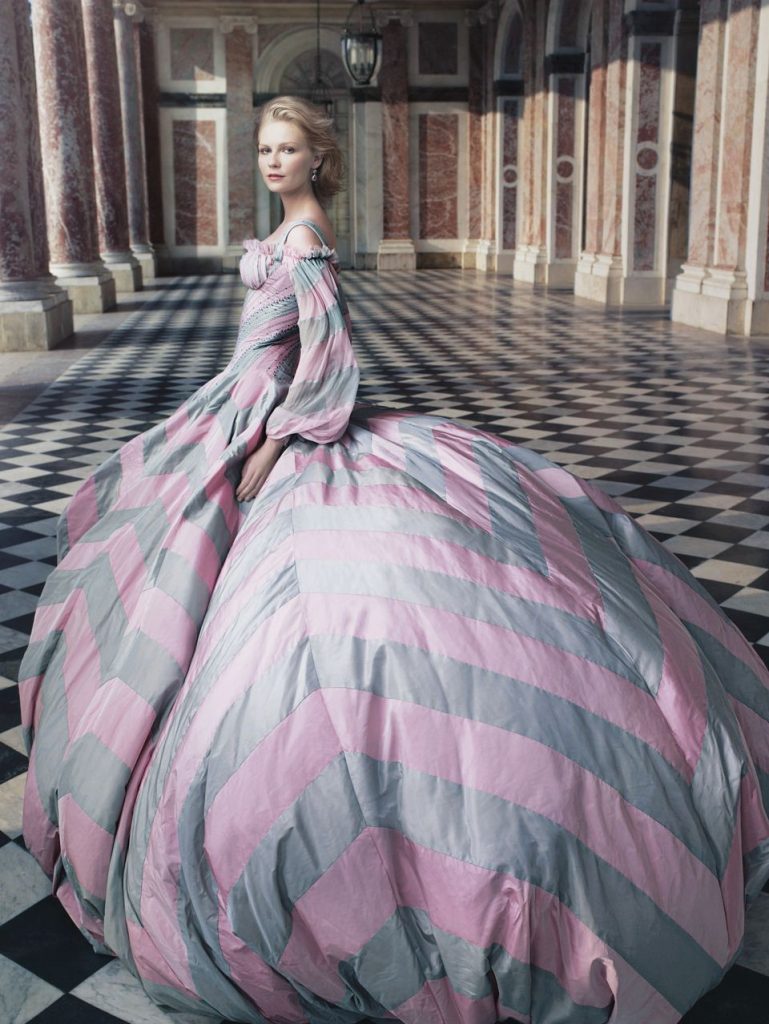
“Teen Queen,” by Kennedy Fraser, was originally published in the September 2006 issue of Vogue.
For more of the best from Vogue’s archive, sign up for our Nostalgia newsletter here.
Sofia Coppola’s film Marie Antoinette,covering the nineteen years that fabulous and tragic woman spent at Versailles, created a sensation when it opened earlier this year in France. It was filmed largely on location in the palace, with unswerving support from the directors of the museum. For the two leading actors—Kirsten Dunst as the young queen and Coppola’s cousin Jason Schwartzman as King Louis XVI—it was a transformative experience to walk in rustling silk and tapping heels through halls filled with ghosts. For Dunst, exquisitely but unstuffily costumed by Milena Canonero (who deserves an Oscar for this work), it was a very sensual role. “You breathe differently in those dresses; you move in a special way,” Dunst says. To prepare herself, on the night a scaled-down crew was filming her in the emotionally charged balcony scene, she walked alone through the palace in the dark. “I could look in those mirrors,” she says. “Be still in myself. Feel my place in that house.”
It is Coppola’s third full-length film, after The Virgin Suicides and Lost in Translation.With a $40 million budget, it is by far her most ambitious project. She was aware that her subject is controversial—that people, especially in France, either see the queen as a saint and martyr or really, really hate her. But Coppola forgot about all that and brought her own Marie Antoinette to life. In her film, history is seen from a very feminine young woman’s point of view. In the director’s mind it forms a trilogy with the previous two films, exploring the theme of young women discovering who they are. The queen’s love of fashion particularly interested her. “You’re considered superficial and silly if you’re interested in fashion,” Coppola says. “But I think you can be substantial and still be interested in frivolity. The girl in Lost in Translation is just about to figure out a way of finding herself, but she hasn’t yet. In this film she makes the next step. I feel that Marie Antoinette is a very creative person.”
In 1770, the fourteen-year-old Archduchess Marie Antoinette left her home in Austria and traveled to meet her fifteen-year-old fiancé, the dauphin, heir to the throne of France. She was an attractive little thing, with blonde hair, blue eyes, a fine pale skin, and the pouting Hapsburg-family lower lip. She was the fifteenth child of a formidable mother, the Empress Maria Theresa, who led her huge empire so efficiently that she went on reading state papers while she was giving birth. At the last minute it had been discovered that the future bride (who liked dancing and playing with children and dolls) could barely read and write. Her mother arranged for a crash education and a makeover, including cosmetic dentistry, a less provincial hairdo, and a complete new wardrobe of French-style clothes. Then the girl rolled through the forest in a special gilded coach with gold roses (symbol of the Hapsburgs) and lilies (symbol of the Bourbons) nodding in a topknot on the roof. Behind the huge glass windows she was like a jewel in a padded case. From now on, her mother had warned her, all eyes would be upon her, and she should do what she was told. Maria Theresa had anxious premonitions; her girl was lively and affectionate in nature but had the attention span of a flea.

ENTOURAGE
Louis XVI, played by Jason Schwartzman (AT REAR), and his wife (Dunst, in pale blue) hold court at a late-night gambling party. The queen’s lover, Axel von Fersen (played by Jamie Dornan, FRONT LEFT), watches longingly from afar. Shot in Paris at the Centre Historique des Archives Nationales, Hôtel de Soubise—where many of the movie’s interiors were filmed. The sumptuous costumes were created by Milena Canonero and the wigs by Rocchetti. Set design by Jean Hughes de Chatillon.
The palaces where Marie Antoinette grew up had thousands of rooms, and she had experienced plenty of grand court ceremony, but there were times of intimate and almost bourgeois family life with her mother and father (the easygoing, pleasure-loving Francis of Lorraine) and her siblings. However, nothing could prepare an outsider for living with the rigid etiquette of Versailles. In a strictly hierarchical system of absolute monarchy, all power derived from the king, who was next in line to God. Everything at the palace was designed to awe. The facade with its huge balconied windows was a quarter-mile long, and its famous mirrored gallery was more like a stage or a street for deities than an ordinary room. An emasculated nobility had to hang out, cap in hand, in hopes of catching the king’s attention (or that of his official mistress) and begging for favors and pensions. Power was reflected in the smallest ritual and gesture. The presence at the humblest human activities of the monarch—dressing, undressing for bed, eating a meal, using a candle or the chamber pot—was an honor for the courtiers and a chance for them to be rewarded for their subservience. Young Marie Antoinette found herself shivering in the cold while princesses of the blood fought over the right to pass her the royal undergarments. Like box hedges on the move, the ladies squeezed into her apartments in panniered skirts to watch circles of quite unnecessary rouge applied to her pink-and-white cheeks.
As her mother had foreseen, the debutante first lady of Versailles was watched by a thousand eyes for the first signs of a faux pas. Gossip, humiliating mockery, and intrigue were the principal court occupations. A lady in court dress in the halls of Versailles was prey to many hazards: catching her skirt in some other lady’s heel, or falling foul of dog poo or food scraps. “Remember,” one nobleman told his daughters who were about to be presented at court, “in this place vice has no consequence. But ridicule kills.” No one could fault Marie Antoinette on her grace of movement; she sailed down the halls and up the stairs as if she were weightless. Almost immediately the teenager made a fashion statement that was a serious violation of etiquette: She tried to jettison the particularly uncomfortable corset, the grand corps, worn by the most important ladies. Under maternal pressure she gave in; the look the corset gave (and a style of court dress unchanged in seven decades) was an integral part of a ceremonial curtsy.

WHO’S THE FAIREST OF THEM ALL?
The stars stroll in the Hall of Mirrors. This VOGUE photo shoot was the first authorized by the Château de Versailles in 25 years.

AFTER HOURS
For seven years, their marriage was unconsummated. Instead, the queen found satisfaction in creating an exquisite appearance. Here, in the park at Versailles, the couple returns home after attending a masked ball in Paris with her clique, the Private Society

THE POWER AND THE GLORY
Louis and Marie Antoinette were young, lonely, and thrown together by fate. “I think they ached for each other,” Schwartzman says. Here, the couple looks out over the palace’s parterre and the Fountain of Latona.