4,000-year-old handprint discovered on ancient Egyptian tomb offering

Researchers have unveiled an ancient Egyptian handprint that was left on a soul house tomb offering 4,000 years ago.

The handprint is just about visible towards the bottom of the soul house underside (pictured here). (Image credit: © The Fitzwilliam Museum, University of Cambridge
Researchers have discovered a 4,000-year-old handprint on a tomb offering from ancient Egypt, providing a rare glimpse into the life of its maker.
The handprint was left on the underside of a “soul house” — a model dwelling that may have been intended to serve as a resting place for a dead person’s soul. These models, which were commonly found with burials, also held food offerings such as bread, lettuce and ox heads, according to a statement from the University of Cambridge in the U.K.
The soul house dates to between 2055 and 1650 B.C. and came from a site called Deir Rifa, located around 174 miles (280 kilometers) north of the city of Luxor in southern Egypt, The Art Newspaperreported. Researchers at the Fitzwilliam Museum, part of the University of Cambridge, discovered the handprint while preparing for the museum’s upcoming Made in Ancient Egyptexhibition.
Whoever made the soul house likely left a handprint behind by handling the clay before it had dried, the researchers said.
We’ve spotted traces of fingerprints left in wet varnish or on a coffin in the decoration, but it is rare and exciting to find a complete handprint underneath this soul house,” Helen Strudwick, the curator of Made in Ancient Egypt and a senior Egyptologist at the Fitzwilliam Museum, said in the statement.
Related: Ancient Egyptian rock art discovered near Aswan may be from the dawn of the first dynasty
Potters created soul houses by building a frame from wooden sticks and coating them with wet clay. The frame then burnt away when the potters fired the clay at a high temperature to turn it into ceramic.
Researchers still have a lot to learn about soul houses. English Egyptologist Sir William Matthew Flinders Petrie (1853 — 1942) coined the term and believed that the houses were used to provide provisions for the afterlife, according to the Egypt at the Manchester Museumblog. However, it’s uncertain whether they were intended to act as houses for the spirit of the deceased or simply as symbolic offerings. The University of Cambridge statement noted that the houses may have served as both.
It’s unclear whether the soul houses represented the deceased’s house or a tomb. Strudwick told The Art Newspaper that soul houses were placed directly over burial shafts, suggesting that they were a cheaper alternative to elaborate tomb chapels that were built beside burial chambers, and thus were used by people who couldn’t afford such luxuries. However, Strudwick noted that she thinks there’s also a connection between soul houses and the idea of the dead being able to return to their homes.
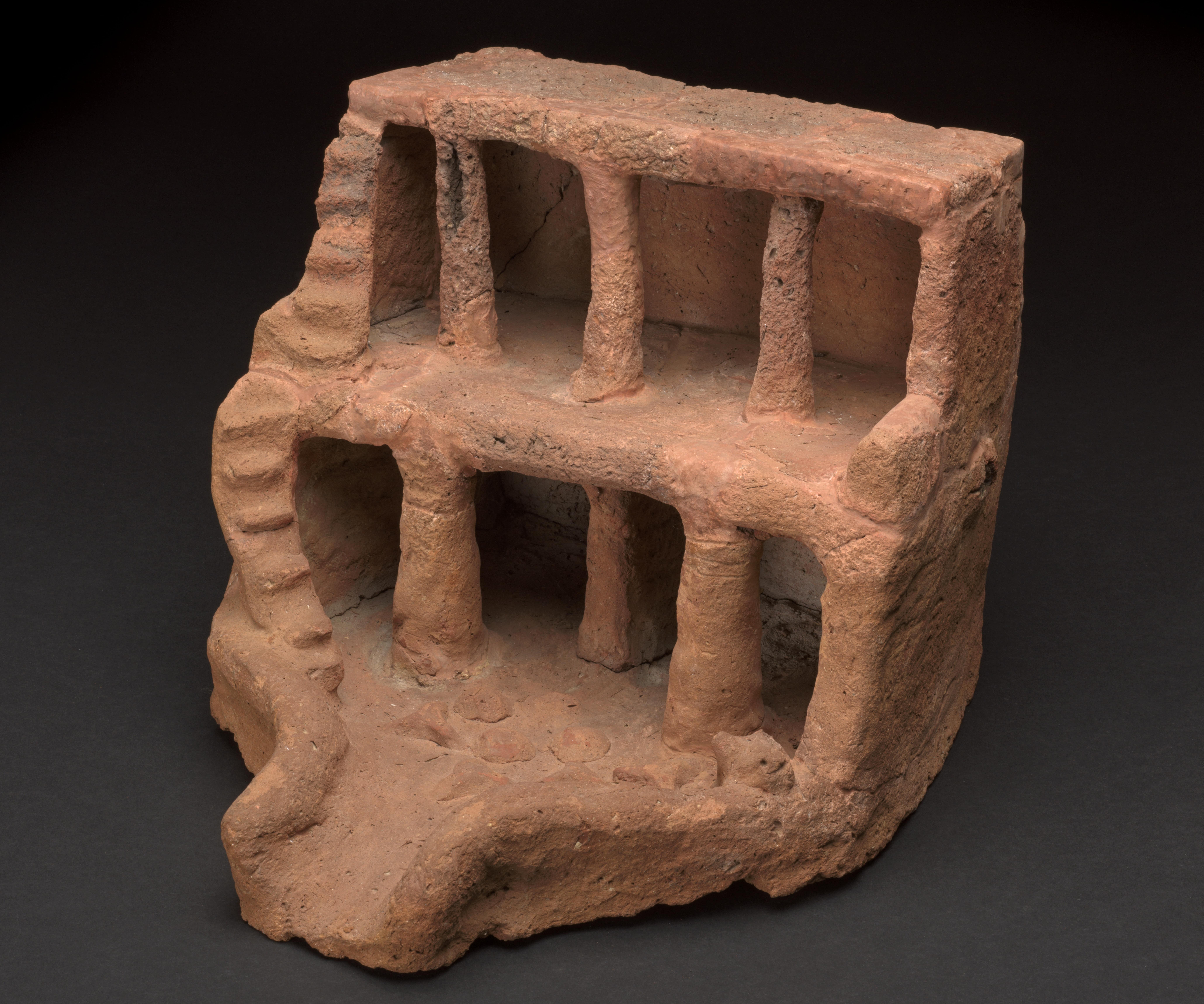
The soul house featured rows of pillars across two levels, with a staircase up to the second level and the roof. (Image credit: © The Fitzwilliam Museum, University of Cambridge.”)
The soul house with a handprint on its underside has two levels with a row of pillars on each. Researchers suspect that the handprint was left by someone moving the model out of a workshop to dry before firing, according to the statement.
This handprint is one of the relatively few glimpses of potters at work to have survived from ancient Egypt.
I have never seen such a complete handprint on an Egyptian object before,” Strudwick said. “You can just imagine the person who made this, picking it up to move it out of the workshop to dry before firing. This takes you directly to the moment when the object was made, and to the person who made it.”