The Big Wheel: When Plastic Meant Freedom
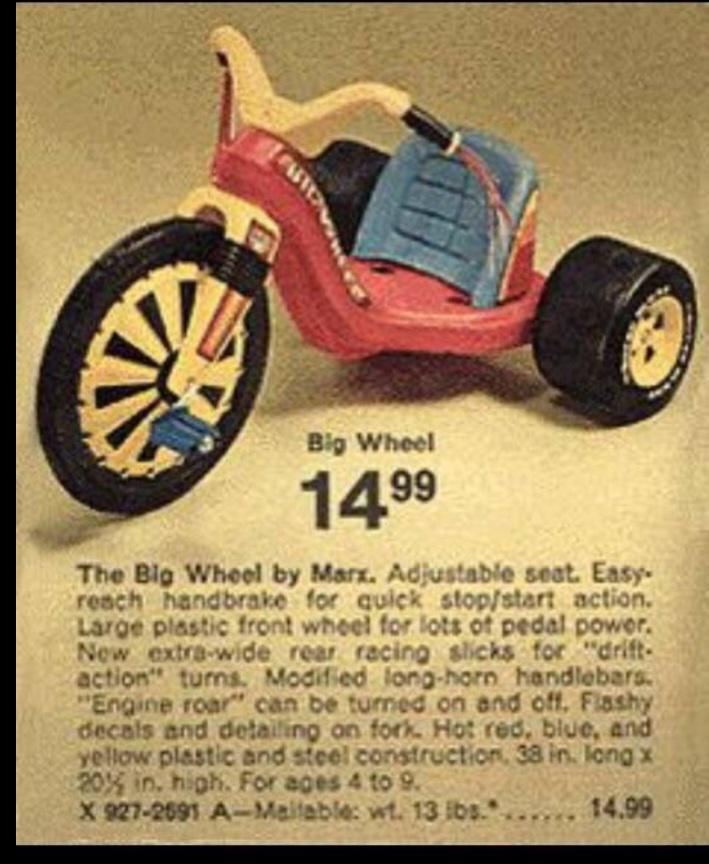
There was a time — long before smartphones, streaming, and seatbelt sensors — when the coolest thing a kid could own wasn’t a gadget, but a chunk of molded plastic on three wheels. And if you grew up in the ’70s or early ’80s, you know exactly what I’m talking about: The Big Wheel.
That low-slung, bright-colored trike wasn’t just a toy — it was a rite of passage. You’d hop on, lean back like a tiny Evel Knievel, and race down the sidewalk, the hollow wheels going thump-thump-thump across every crack in the pavement. No helmet, no pads, just a plastic throne and a wild sense of invincibility.

Many of us never owned one ourselves — we rode our friend’s until the front tire went flat, or until we convinced our parents to upgrade us to the legendary Green Machine with its hand brake and spin-out powers. But whether it was a Big Wheel or a Green Machine, it didn’t matter. The feeling was the same: freedom. That first taste of going fast on your own terms.
People on Reddit’s r/70s thread reminisced like old friends at a reunion.
“I loved mine dearly. Early model. No saddlebag, no hand brake. Kids were tough in those days,” wrote one user.
“To brake, you just started pedaling backward,” another remembered.
And of course, someone added what every kid from that era can still hear: “Thump… thump… thump…” — the soundtrack of a thousand summer afternoons.
They make one.

Sure, the Big Wheel wasn’t built to last. Its hollow wheels wore out fast, the axles wobbled, and after enough skids and spins, you’d have to drag it home with the front tire shredded like a war trophy. But that was part of the charm. It didn’t have to last — it only had to make you feel unstoppable for one more day.
Looking back, that was the beauty of toys like the Big Wheel. They weren’t collectibles or “interactive learning tools.” They were adventures waiting to happen. For $15 (about $75 in today’s money), you bought the ultimate childhood experience — scraped knees, daring races, and laughter echoing through the neighborhood until the streetlights came on.
And yes, some kids had the Knight Rider version, some made ramps, and a few ambitious ones even wrapped worn-out wheels with rubber bands to keep going. Because that’s what we did — we made it work, we kept the fun rolling.
The Big Wheel wasn’t just a toy — it was a symbol of a simpler time. A time when every driveway was a racetrack, every hill a challenge, and every skid a victory.

We didn’t need screens. We just needed plastic wheels, a sunny afternoon, and the courage to pedal faster.
Big Wheels keep on turnin’.









Post Comment