U.S. Strikes Iran’s Nuclear Sites: Trump Announces “Spectacular Success” Amid Escalating Tensions
June 22, 2025
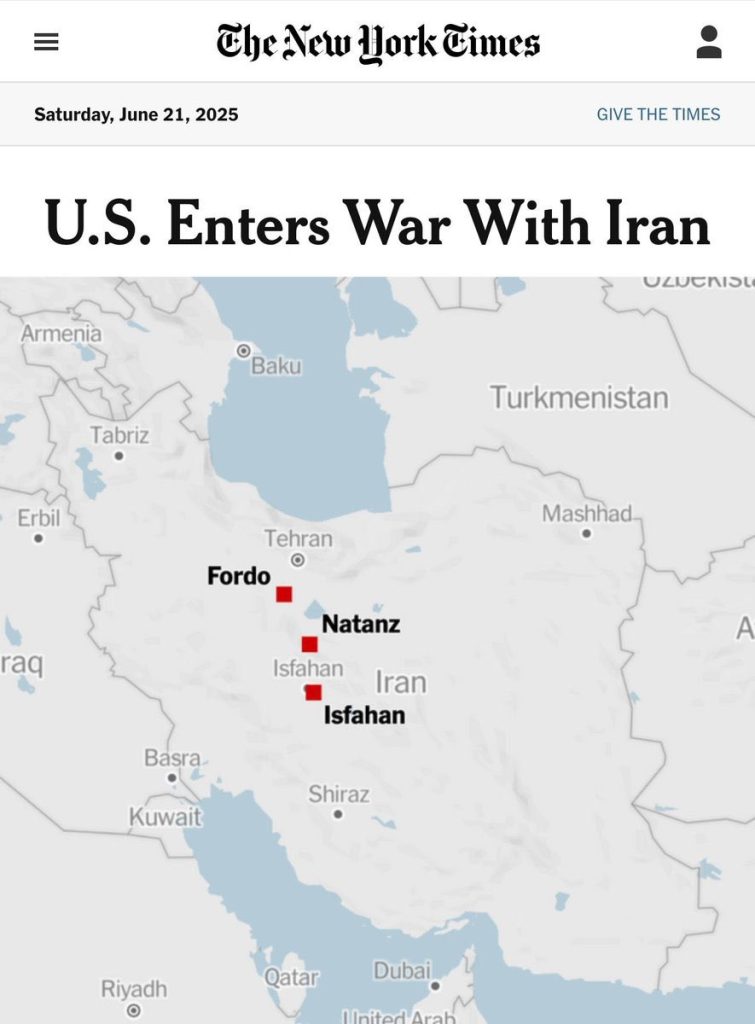
In a dramatic escalation of the ongoing conflict between Israel and Iran, the United States launched precision airstrikes on three key Iranian nuclear facilities early Sunday, marking its first direct military engagement in the nine-day-old war. President Donald Trump, in a brief address to the nation from the White House on June 21, declared the strikes a “spectacular military success,” claiming that Iran’s nuclear enrichment capabilities at Fordo, Natanz, and Isfahan had been “completely and totally obliterated.” The move has heightened fears of a broader regional conflict, with Iran vowing retaliation and global leaders urging de-escalation.
The U.S. Strikes: A Bold Intervention
The U.S. military operation targeted Iran’s heavily fortified Fordo Fuel Enrichment Plant, the Natanz uranium enrichment center, and facilities in Isfahan, using advanced weaponry, including bunker-busting bombs carried by B‑2 stealth bombers. Trump emphasized that the objective was to dismantle Iran’s nuclear program, which he described as a threat posed by “the world’s No. 1 state sponsor of terror.” In a post on Truth Social, he warned Iran that any retaliation would be met with “force far greater than what was witnessed tonight,” signaling a readiness for further action if necessary.
The strikes followed days of speculation about U.S. involvement, as Israel’s bombing campaign against Iran’s nuclear and military sites intensified. Israeli Prime Minister Benjamin Netanyahu praised Trump’s “bold decision,” calling the U.S. operation a “historic” move that “will change history” and could pave the way for “a future of prosperity and peace” in the Middle East. Israeli President Isaac Herzog echoed this sentiment, thanking Trump for an operation that “serves the security interests of the entire free world.”
Trump’s Announcements and Rhetoric
In his 3½-minute address, Trump, flanked by Vice President JD Vance, Secretary of State Marco Rubio, and Defense Secretary Pete Hegseth, framed the strikes as a necessary response to Iran’s long-standing hostility. He accused Iran of causing “hundreds of thousands of deaths” across the Middle East and reiterated his oft-cited grievance that for “40 years Iran has been saying, ‘Death to America, death to Israel.’” Trump also referenced the 2020 U.S. drone strike that killed Iranian military leader Qasem Soleimani, underscoring his administration’s hardline stance against Tehran.
Trump announced that Defense Secretary Hegseth and Chairman of the Joint Chiefs of Staff Dan Caine would hold a press conference at the Pentagon on Sunday at 8 a.m. to provide further details on the operation. However, he offered no specifics on the strikes’ immediate impact or the administration’s next steps, instead closing his remarks with a call for peace and a blessing for “Israel, the Middle East, and America.”
On Truth Social, Trump’s tone was more confrontational. He claimed the U.S. had achieved “complete and total control of the skies over Iran” earlier in the week and suggested that Iran’s Supreme Leader, Ayatollah Ali Khamenei, was “an easy target” but safe for now. These statements, coupled with his earlier demand for Iran’s “unconditional surrender,” have fueled concerns about the potential for further escalation.
Iran’s Response and Regional Fallout
Iran’s leadership condemned the U.S. strikes as a violation of international law and the Nuclear Non-Proliferation Treaty (NPT). Foreign Minister Abbas Araghchi, in a post on X, asserted Iran’s “legitimate right to respond” and warned that the attacks “will have everlasting consequences.” Iran’s nuclear agency vowed to continue its nuclear program despite the damage, while state media reported that Israeli strikes alone had killed at least 400 people, including 54 women and children.
Supreme Leader Ayatollah Ali Khamenei, reportedly in a secure bunker with limited communication, has yet to issue an official response to the U.S. strikes. However, earlier in the week, he dismissed Trump’s threats as “absurd rhetoric” and warned that U.S. intervention would cause “irreparable damage.” Iran’s military detected a fresh barrage of ballistic missiles launched toward Israel shortly after the U.S. strikes, signaling its intent to retaliate.
The strikes have triggered alarm across the region. The Houthi rebels in Yemen, backed by Iran, declared Trump “must bear the consequences” and threatened to target U.S. Navy warships in the Red Sea. Hezbollah, another Iran-aligned group, expressed solidarity with Tehran but has so far refrained from direct involvement due to domestic pressures in Lebanon.
International Reactions and Calls for De-Escalation
Global responses to the U.S. strikes have been mixed. The United Nations called for immediate de-escalation, while Colombia and Mexico urged all parties to resume negotiations. Chilean President Gabriel Boric and Venezuela’s Foreign Affairs Ministry condemned the attacks, with the latter labeling them “military aggression.” Russia, a key Iranian ally, warned against further U.S. involvement, with Foreign Ministry spokesperson Maria Zakharova raising concerns about the risks of striking nuclear materials.
In the U.S., political reactions highlighted deep divisions. Senator John Fetterman (D‑PA) praised the strikes as “the right move,” arguing that Iran “cannot have nuclear capabilities.” Conversely, Representative Sara Jacobs (D‑CA) called the action “unconstitutional” and warned of the risk of “another endless and deadly war.” Senator Jeanne Shaheen (D‑NH) urged Trump to brief Congress and avoid rushing into conflict, while Senate Minority Leader Charles Schumer received only a “perfunctory notification” about the strikes.
The Path Forward
The U.S. strikes come after a week of intense fighting between Israel and Iran, sparked by Israel’s initial attacks on June 13 targeting Iranian nuclear and military sites. Iran retaliated with missile and drone strikes, including a devastating attack on Soroka Medical Center in southern Israel, which killed at least 24 people and injured dozens. Trump’s decision to intervene followed days of deliberation, with reports indicating he had approved war plans but held off in hopes of a diplomatic breakthrough.
Despite Trump’s earlier calls for a nuclear deal, diplomacy appears stalled. Iranian officials signaled flexibility in negotiations if the U.S. could halt Israel’s attacks, but Trump dismissed such talks as “very hard” to pursue. European foreign ministers met with Iran in Geneva on Friday, but no agreement was reached on ending uranium enrichment, which Iran considers a “bold red line.”
As air-raid sirens blare in Israel and Tehran reports increased air defense activity, the region braces for Iran’s response. The U.S. has evacuated some embassy personnel from Israel and is coordinating flights and cruise ships for American citizens seeking to leave. With tens of thousands of U.S. troops stationed in the Middle East, the risk of retaliation against U.S. bases looms large.
Conclusion
President Trump’s decision to strike Iran’s nuclear facilities has thrust the United States into a volatile conflict, raising the stakes in an already tense region. While Trump and Netanyahu frame the operation as a decisive blow against Iran’s nuclear ambitions, the lack of a clear diplomatic off-ramp and Iran’s vows of retaliation suggest the crisis is far from resolved. As the world watches, the next few days will be critical in determining whether this bold move leads to peace—or a wider, more destructive war.
Stay tuned for updates as this story develops. For more on global affairs and U.S. policy, subscribe to our blog.