Mom, 35, Describes the First Signs of Pancreatic Cancer Doctors Missed for Months: “I Was Scared — I Knew Something Was Wrong”

At the end of 2024, Amy Skoutelas felt unstoppable.
The 35-year-old mother of three from Gilbertsville, Pennsylvania, had just completed a major fitness transformation. After the birth of her third child, she pulled out the Peloton bike her husband had bought months earlier and finally “dove in.” Five workouts a week. A full lifestyle reset. Thirty pounds lost. And, for the first time in years, she felt strong.
“I was feeling the healthiest I’ve ever been,” she recalls. Her life felt stable, happy, and lucky — healthy kids, no family history of cancer, no warning signs at all.
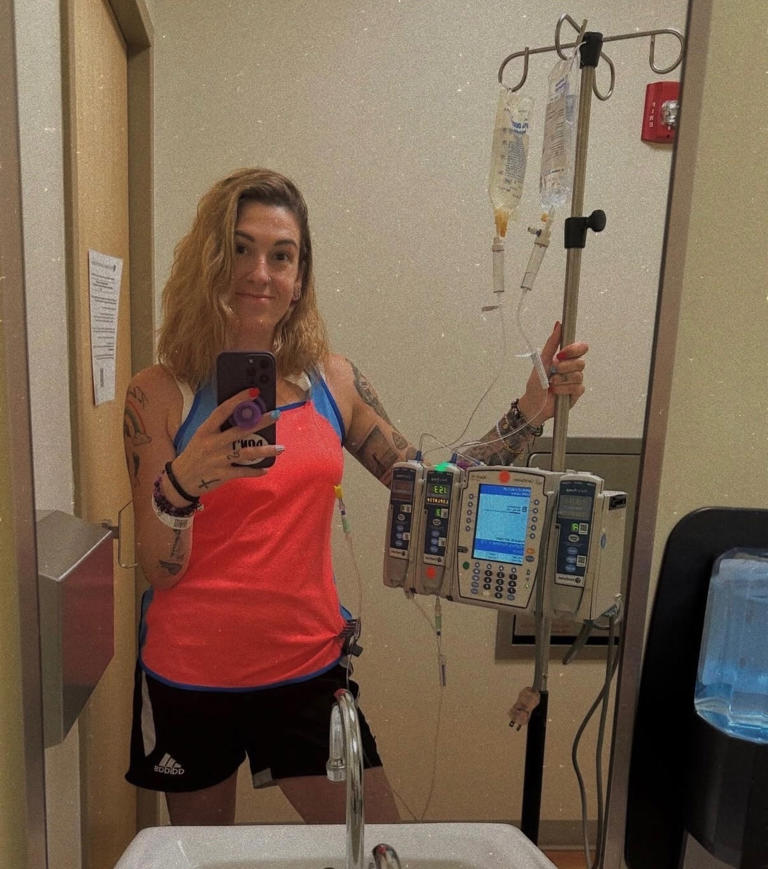
Until everything changed.
It Started With a Stomach Pain That “Wasn’t Normal”
One evening in January, after a normal dinner, Amy felt a sharp stomach pain and a strange fullness. At first she assumed it was gas — but it didn’t go away.
“I kind of panicked because that wasn’t my norm,” she says. She went to the emergency room a few days later, driven partly by fear and partly by her long-standing health anxiety. “I don’t wait and see. I need to know immediately what’s going on with me.”
Bloodwork showed elevated lipase — a pancreatic enzyme — so doctors suspected mild inflammation. They ordered a CT scan with contrast, but after reviewing the results, they told her everything looked “normal.” She was discharged with instructions to follow up with a gastroenterologist.
Amy thought the situation was handled.
It wasn’t.
Unbeknownst to her, the detailed scan contained a tiny but important clue.
A clue no one noticed — or told her about — for months.
Dismissed as Constipation and “Typical GI Issues”
When her GI specialist received the ER report, they received only the verbal summary, not the actual scan images. The summary stated her pancreas was normal.
Amy was told she was probably constipated. So she increased fiber. She drank more water. She followed instructions. Yet her symptoms only grew worse.
She developed:
- persistent bloating
- gas that wouldn’t go away
- a constant need to have a bowel movement
- a “gnawing” stomach sensation
- severe acid reflux
- eventually, nonstop diarrhea

“I just knew something wasn’t right,” she says. But every appointment ended the same way: GI issue, nothing serious, try something new, don’t worry.
She underwent X‑rays, bloodwork, an upper endoscopy, and even a gastric emptying study. All normal.
Amy kept pushing — but her symptoms kept being dismissed.
“I was scared,” she says. “I felt like no one was listening.”
A Second Opinion Brings the Truth
By April, Amy couldn’t take it anymore. She found a new gastroenterologist who immediately ordered an MRI.
That MRI revealed what everyone had missed: a 1.7‑centimeter mass in the tail of her pancreas, blocking one of its ducts.
“It was very small, but it was blocking the duct, which is why I had the acid reflux, the indigestion, the diarrhea,” she explains.
A biopsy brought the words no 35-year-old mother expects to hear:
Pancreatic adenocarcinoma.
“I just collapsed on the floor,” she remembers. “I told the doctor, ‘I don’t want to die. I have three kids.’ I was in complete disbelief.”
The Tumor Had Been Visible Months Earlier
Her new care team at the University of Pennsylvania reviewed all her prior medical records — including the CT scan from January.
At her first appointment, her surgeon pulled up the scan and pointed directly at the tumor.
“I was like… ‘Are you kidding?’”
It had been there all along — tiny but visible.
Amy felt let down by the system that missed it, but her new surgeon gave her hope. Her cancer was Stage 3 — serious, but still potentially treatable.
There was no time to waste.
Emergency Surgery and an Intense Treatment Plan
On May 23, Amy underwent a distal pancreatectomy, where surgeons removed the tail and body of her pancreas along with her spleen. They dissected 35 lymph nodes; seven showed cancer involvement.
She considers herself extremely fortunate: many Stage 3 patients are not eligible for surgery at all.
“I had clear margins. It hadn’t metastasized,” she says. “It spread to some lymph nodes, but it was still localized.”
After recovering from surgery, she started aggressive chemotherapy — 12 rounds of folfirinox, one of the harshest regimens used in cancer care.
“It’s been a really intense, crazy ride,” she says.
As of September, her scan showed no evidence of disease. She recently completed her 10th round of chemo and continues treatment with a goal that doctors describe as “intent to cure.”
Why Pancreatic Cancer Is So Often Missed
Pancreatic cancer is notoriously difficult to detect early because:
- the pancreas is deep inside the abdomen
- tumors rarely cause symptoms until they grow
- early symptoms mimic common digestive disorders
- routine screening does not exist
By the time symptoms appear, the cancer is often advanced. That’s why the five-year survival rate is only 13%.
Amy believes her persistence is what saved her life.
“If I had waited, I probably wouldn’t have seen my 40th birthday,” she says.
Living in the Present — Not the “What Ifs”
After years of battling health anxiety, Amy’s cancer journey forced her into a new perspective.
“Cancer was the worst possible thing… but here I am, facing it,” she says. “I’m already in the pits, so what else do I have to fear?”
She now focuses on:
- time with her husband, Stefanos
- watching her kids grow
- small daily joys, like autumn leaves
- crocheting
- being present instead of worrying
“My whole life was the ‘what ifs.’ Now it’s about right now. I can finally enjoy things.”
“Be Your Own Best Advocate.”
November is Pancreatic Cancer Awareness Month, and Amy hopes her story encourages others to trust their instincts.
“I want to spread my story, not to scare people, but to say: you know yourself. If something is not right, push. Get a second opinion. Don’t let anyone dismiss your concerns.”
Her message is simple and powerful:
If she hadn’t advocated for herself, she might not be here today.
If you want, I can also create:











Post Comment